Elysan 4 – The Ultimate Audiophile Experience?
Wharfedale presents the Elysan 4 as a high-end floorstanding speaker with exceptional clarity and precision. Advertised with deep, powerful bass, crystal-clear highs, and a perfectly balanced midrange, it promises a true audiophile experience. Featuring premium materials and advanced engineering, Wharfedale claims it delivers studio-quality sound with unmatched detail. Marketed as a luxury speaker built for perfectionists, the Elysan 4 is positioned as a benchmark in high-fidelity audio.
All drivers are Scan-Speak, the cheapest ones.
Each costs approx. 60 USD.

Published Specifications
Frequency Response: 30Hz – 22kHz (+/- 3dB)
Sensitivity: 92dB (2.83V @ 1m)
Impedance: 4Ω nominal (compatible with 8Ω amplifiers)
Drive Units: 27x90mm AMT tweeter, 150mm (6.0") midrange, dual 220mm (8.5") bass drivers
Recommended Amplifier Power: 25W – 250W
Real Specifications
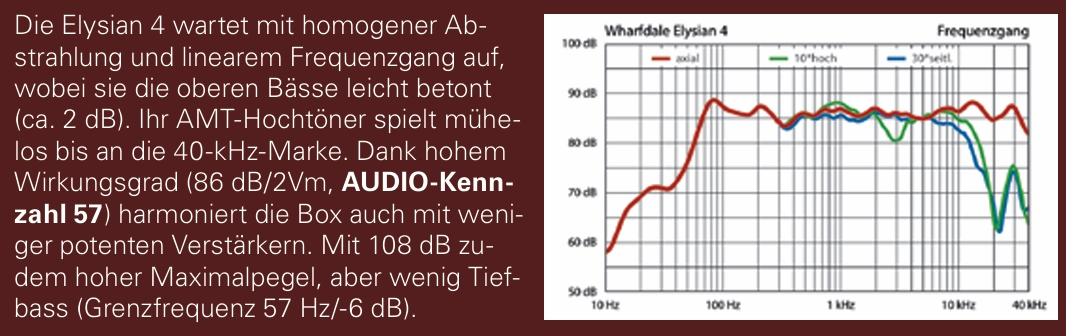
Frequency Response: 57Hz – 22kHz (+/-6dB)
Sensitivity: 86dB (2.83V @ 1m)
Impedance: 4Ω nominal (compatible with 8Ω amplifiers)
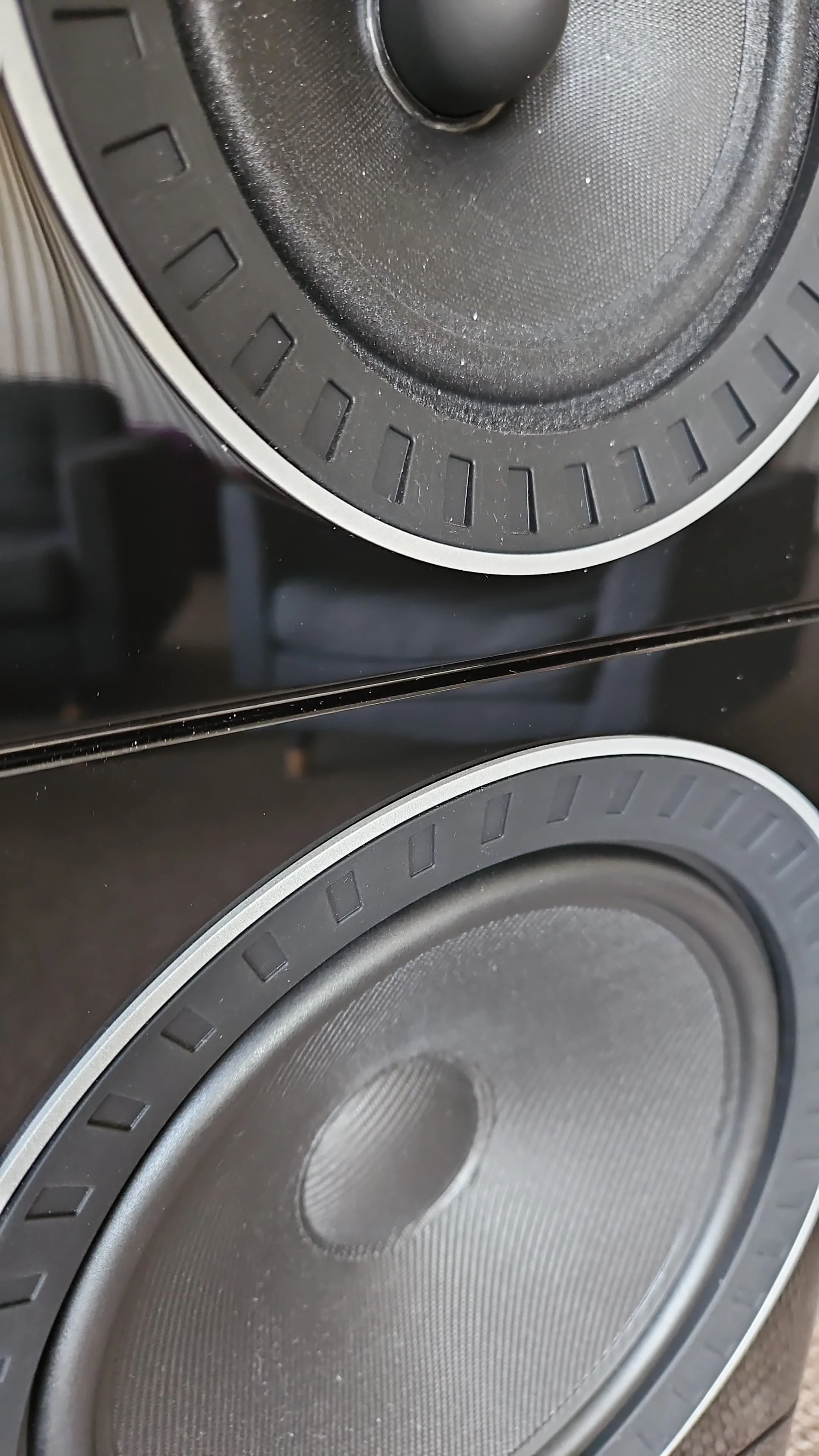
Drive Units: 27x90mm AMT tweeter, 100mm (4") midrange, dual 177mm (7") bass drivers
Recommended Amplifier Power: 25W – 250W
The Elysian 4 offers homogeneous dispersion and a linear frequency response, with the upper bass slightly emphasized (approx. 2 dB). Its AMT tweeter plays effortlessly up to the 40-kHz range. Thanks to high efficiency (86 dB / 2V/m, AUDIO rating 57), the speaker also works well with less powerful amplifiers. With 108 dB, it reaches a high maximum volume, but offers little deep bass (cutoff frequency 57 Hz / –6 dB).
-

Separate bass and mid-high measurements
Near field measurements, microphone in front of bass driver 5cm, microphone in front of tweeter-mid 1m distance.
Bi-wiring posts used when measuring bass and mid-high modules. -

Full range measurements at 1m
Lack of bass and highs is evident